 Daily Crypto Briefs
DAVOS, Switzerland, Jan. 24, 2026
BlackRock CEO Larry Fink said tokenized markets work best on “one common blockchain,” as ether held near $2,960 and RWA.xyz data showed roughly $23.2 billion in tokenized real-world assets in circulation.
Fink’s message was simple: tokenization, the practice of turning ownership claims like fund shares or bonds into blockchain tokens, is getting closer to core market plumbing, and fragmentation across many networks can keep liquidity and compliance stuck in silos.
Market snapshot: Bitcoin traded around $89,480 on Jan. 24, up about 0.3% over 24 hours with roughly $34.9 billion in 24-hour volume, while ether traded around $2,958, up about 0.6% with roughly $17.8 billion in volume, according to CoinGecko and CoinGecko’s ether data.
On the tokenization side, RWA.xyz showed about $23.2 billion in tokenized real-world assets, with Ethereum representing about 60% of tracked value at the time of writing. Its tokenized U.S. Treasuries dashboard showed roughly $10.1 billion of tokenized Treasury value across tracked products.
The chart below shows how much of the tracked tokenized asset value is attributed to Ethereum versus other networks, using RWA.xyz’s aggregation.
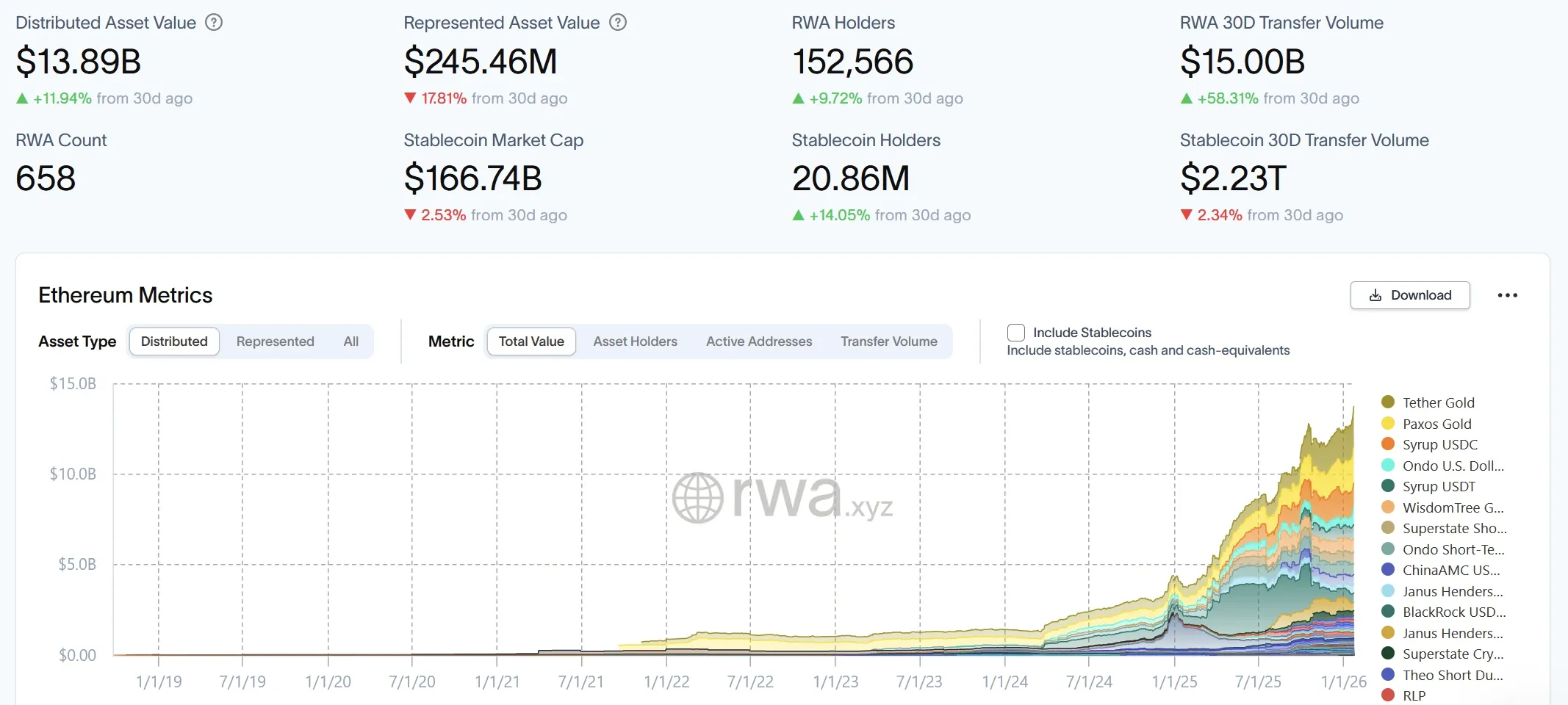
Ethereum share of tracked tokenized real-world asset value.
Fink calls for one blockchain in tokenization
In a partial transcript included in an SEC filing, Fink framed the prize as a single settlement rail for switching between tokenized cash and risk assets: “We have one common blockchain. We could reduce corruption.”
Put simply, Fink is describing a market where cash and securities share the same rails. A “settlement rail” is the system that makes a trade final, when the buyer pays and the seller’s ownership transfer is complete.
If tokens for cash, Treasuries, and equities all live on the same network, a portfolio shift can become a software-driven exchange between token types rather than a chain of messages across brokers, custodians, and clearing layers. That is where cost and time savings can come from, especially during stress when delays can amplify liquidity problems.
The same setup can also tighten compliance. Rule checks can be enforced at the token level, so a transfer can fail if a wallet is not allowed to hold the asset, instead of being caught after the fact by a back office.
The remarks circulated during World Economic Forum week in Davos, and DL News reported that the comments were part of a Davos conversation about tokenization’s next phase.
Tokenized Treasuries and BlackRock’s BUIDL put settlement on-chain
Tokenization is often described as putting assets “on-chain,” but the practical change is operational. A token can move in minutes between wallets that pass required checks, while the issuer and transfer rules decide who is allowed to hold it and when redemptions happen.
Settlement is the hidden part of that story. In many stock markets, trades can take more than a day to fully settle, and big intermediaries sit between the two sides to manage counterparty risk and bookkeeping. Tokenized settlement aims to shrink that gap by letting payment and delivery move together.
That standardization argument is already visible in the most adopted use case: tokenized short-term U.S. government debt. BlackRock has described BUIDL as a tokenized fund issued on a public blockchain in a corporate newsroom press release, and RWA.xyz data shows the product now spans multiple networks as issuers chase distribution.
On RWA.xyz, BUIDL appears across networks including Ethereum, Solana, Polygon, Arbitrum, Avalanche, Optimism, BNB Chain, and Aptos. That kind of multi-network spread can widen access, but it also creates the problem Fink is pointing to: liquidity is split across places, and interoperability becomes a policy and engineering question, not a default feature.
Tokenized Treasuries have grown because they solve a simple demand: a blockchain-native way to park cash in an instrument backed by U.S. government debt while keeping the ability to move value quickly. In many products, investors enter and exit with stablecoins, which are blockchain tokens designed to track the U.S. dollar.
The race is not limited to one manager. Firms are also testing tokenized collateral and post-trade workflows, including DTCC’s plan to mint tokens representing DTC-custodied Treasuries on Canton, which we covered in DTCC’s Quadrillions Move Toward Onchain Treasuries on Canton Network.
Those pilots matter because the promise of tokenization is not only about issuing an asset. It is about re-wiring how margin, collateral, and cash move between participants so trading and financing can be done with less manual reconciliation.
Equities are moving in the same direction, just with more legal and custody questions. RWA.xyz recently put tokenized stocks around the $1.5 billion mark, which we broke down in Tokenized Stocks Hit $1.5B in Market Cap as Onchain Equities Broaden.
Stocks add extra complications because ownership rights are tied to corporate law, transfer agent records, and disclosure rules. That is part of why early growth has clustered in Treasuries and cash-like products where the legal structure is easier to standardize.
Standard vs more chains: liquidity, compliance, and single-network risk
A single blockchain standard is not just a tech preference. It can shape where liquidity sits, how quickly tokenized cash can swap into Treasuries or equities, and how cleanly compliance checks follow the asset across venues.
The tradeoff is concentration. A shared rail can become a single point of failure for outages, censorship disputes, or rule changes, and it can pull more regulatory pressure onto the network that becomes the default settlement layer.
There is also a governance issue. If one chain becomes the market’s default, decisions about upgrades, fees, and transaction ordering matter to everyone using it, not just crypto-native traders. That can put market structure questions, such as who controls validators and what happens during network stress, into the center of financial policy.
The upside is that standards can create trust at scale. Standard message formats, consistent compliance hooks, and predictable settlement rules are what let markets connect without every participant building custom plumbing for every counterparty.
What is still unclear is what “one blockchain” means in practice for global markets. Fink did not name a specific network in the transcript, and details like governance, permissioning, and how regulated intermediaries would connect were not disclosed.
For U.S. readers, the next catalyst is policy clarity on who supervises tokenized securities and on-chain settlement rails, a split we map in US Crypto Regulation and Policy in 2026: A Practical Guide. Separately, NYSE and other incumbents keep signaling they want always-on trading and faster settlement, a theme we track in NYSE Tokenized Securities Platform: 24/7 Trading and Instant Settlement.
Watch two data points next: whether tokenized Treasury value continues to climb on dashboards like RWA.xyz, and whether tokenized “cash” products gain enough scale that large investors can move between risk and safety without leaving the tokenized stack. If tokenized markets stay fragmented across chains, interoperability will keep acting like a tax on liquidity.
Stay up to date
Get the latest crypto insights delivered to your inbox
Primary sources and further reading
| Source | Title |
|---|---|
| | SEC filing (Form 425): Partial transcript quoting Larry Fink on tokenization |
| | RWA.xyz: Global tokenized real-world assets dashboard |
| | RWA.xyz: Tokenized U.S. Treasuries dashboard |
| | CoinGecko: Ethereum price |
| | CoinGecko: Bitcoin price |
| | BlackRock press release: BlackRock launches first tokenized fund issued on a public blockchain |
Fact-checked by: Daily Crypto Briefs Fact-Check Desk
Frequently Asked Questions
What did Larry Fink say about tokenization at Davos?
In remarks circulated during World Economic Forum week, Fink said the move toward tokenization is “necessary” and argued markets could benefit if investments and tokenized cash sat on “one common blockchain,” according to a partial transcript included in an SEC filing.
Did Larry Fink name Ethereum as the one blockchain?
No. The transcript does not identify a specific chain. Separately, RWA.xyz data showed Ethereum represented about 60% of tracked tokenized real-world asset value at the time of writing.
What is tokenization of assets?
Tokenization is issuing a blockchain token that represents an ownership claim or exposure, such as fund shares or bonds. The token can move on a network, while the issuer and transfer rules decide who can hold it and how redemptions work.
What is a settlement rail in finance?
A settlement rail is the system that makes a trade final, when payment and the ownership transfer are completed. Tokenized settlement aims to move those steps together in software instead of across multiple intermediaries.
How big is the tokenized real-world asset market right now?
RWA.xyz showed about $23.2B in tokenized real-world assets and about $10.1B in tokenized U.S. Treasuries across tracked products as of Jan. 24, 2026.
What is BlackRock’s BUIDL fund?
BUIDL is BlackRock’s tokenized money market-style product. BlackRock has described it as a tokenized fund issued on a public blockchain in its corporate newsroom materials.