 Daily Crypto Briefs
WASHINGTON, Mar. 15, 2026
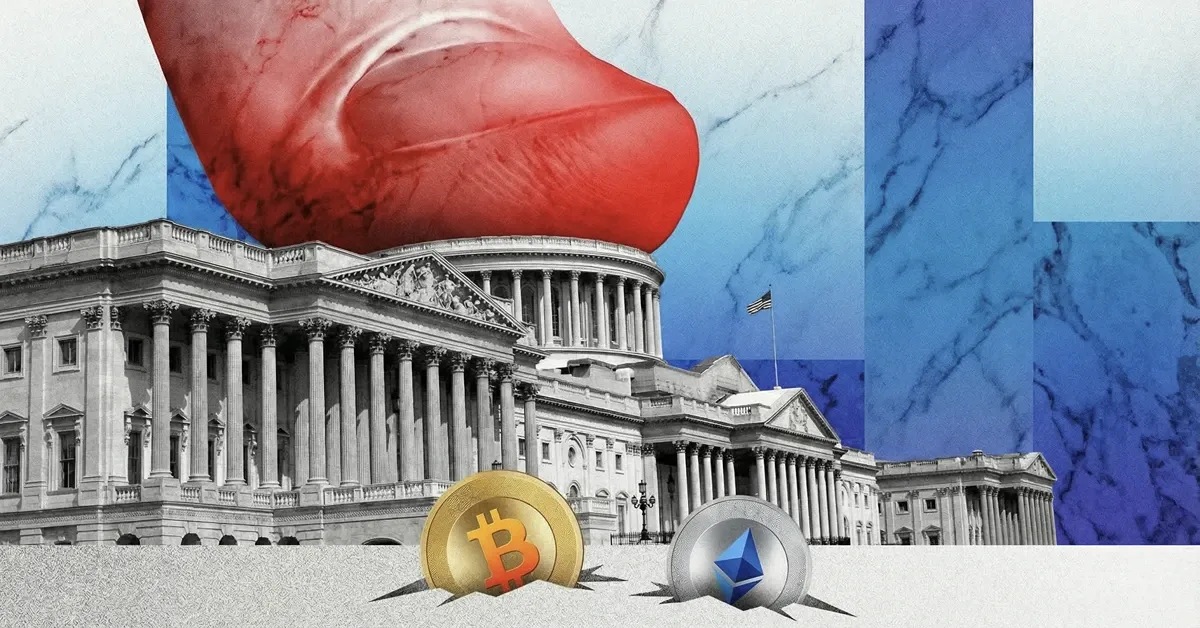
The CLARITY Act’s path to becoming law in 2026 looks narrower after Senate delays and unresolved stablecoin rewards. Polymarket odds on whether the bill will be signed into law in 2026 dropped to 56% on March 15. That is down from an 82% late-February peak, and 62% on March 11.
Clarity Act signed into law in 2026? Live

Galaxy Research has been warning for months about the importance of the Senate calendar, and now the late April period is becoming the last clean committee window for a 2026 path, though lawmakers have not published that as a formal deadline.
If negotiators release the text soon, Polymarket’s 56% odds could rebound fast: the House is done, and the Senate still has time. If committee action stalls further into spring, the market will likely see 2026 as a tougher path, not just a delay.
H.R. 3633, the House’s market-structure bill, passed the House and was received in the Senate on July 17, 2025, according to Congress.gov. But the Senate Banking Committee’s Jan. 15, 2026 markup was postponed, and no replacement CLARITY date appears on the committee’s public markups calendar, leaving the process stuck on timing as much as substance.
Market Snapshot: Separately, market data showed bitcoin at about $71,484, up roughly 1.06% over 24 hours, with about $20.76 billion in 24-hour volume and a market capitalization near $1.43 trillion at the time of writing.
Bitcoin (BTC) - 48-hour snapshot
BTCThe public explanation for the bottleneck remains stablecoin rewards. In an ICBA policy update, community banks warned that wallet and issuer models can end up “diverting funds away from community bank deposits as consumers ‘chase yield,’” capturing why banks keep pressing lawmakers to limit or tightly define how digital-dollar rewards work.
CLARITY Act odds fall as the Senate schedule stays stalled
The current setup is simple. The House has already moved its bill, but the Senate still has to publish compromise language, move the legislation through committee, and get floor time. The longer that slips, the harder it becomes to fit a market-structure bill into a calendar already crowded by appropriations fights and other financial-policy work.
That is why the Jan. 15 postponement still matters two months later. Daily Crypto Briefs covered that canceled markup in US Senate Voting On CLARITY Act Has Been Canceled, and the committee’s current public calendar still does not show a replacement CLARITY markup. On process alone, that keeps the bill in a weaker position than headline optimism implied in late February.
Galaxy Research has framed this as a calendar problem as much as a drafting problem. In January, CryptoSlate reported that Galaxy’s Alex Thorn viewed stablecoin yield as the immediate Senate flashpoint. The late-April pressure now circulating among traders is an inference from that still-unresolved policy fight and the shrinking number of realistic committee slots, not a Senate-published cutoff date.
Polymarket’s move from above 80% in late February to 56% on March 15 shows that traders are no longer pricing the CLARITY Act as a near-certain 2026 formality. Instead, they are pricing an unfinished negotiation.
Stablecoin rewards remain the biggest CLARITY Act fight
The argument is not mainly about whether stablecoins should exist. It is about who gets the economics. If a user can hold tokenized dollars and earn something close to market rates, banks risk losing cheap deposits that help fund lending and payments businesses. If lawmakers shut that feature down, crypto firms lose one of the clearest consumer-use cases for onchain dollars.
That same split has shaped our coverage for months. We detailed earlier this year why incumbents see reward-bearing stablecoins as direct deposit competition rather than a neutral product upgrade. We also tracked how that dispute moved from industry lobbying into open political messaging.
The substance also overlaps with the bill itself. The House text on GovInfo tries to draw cleaner lines around digital commodities, trading venues, and permitted payment stablecoins, but the market still needs to know where Senate negotiators land on rewards, wallet structure, and the degree to which banks can wall off competition from tokenized cash products.
The restrained conclusion from the current record is that the bill is not dead, but the unresolved rewards language is still doing real legislative damage. The more this turns into a fight over preserving bank funding rather than clarifying market structure, the harder it becomes to sell the bill as a clean regulatory framework.
What to watch before late April on H.R. 3633
The next meaningful catalyst is a posted Senate Banking markup date or published compromise language that shows, in plain terms, whether stablecoin rewards are being narrowed, preserved, or split into separate categories.
If negotiators produce that text soon, Polymarket’s odds of 56% can rebound quickly because the House leg is already done and the Senate calendar would still have room to work with. If no committee action appears deeper into spring, the market will likely keep treating 2026 as a harder legislative path rather than a scheduling delay.
That is the practical implication for crypto markets. Without a bill, firms still face a patchwork of SEC, CFTC, banking, and state-level interpretations, a dynamic we mapped in our broader U.S. crypto regulation outlook for 2026. With a bill, the industry still needs to see how the Senate rewrites the parts that touch money-like products, disclosures, and exchange registration.
What remains unknown is whether lawmakers can settle the rewards dispute before the calendar becomes its own veto. Watch the Senate Banking schedule, watch for new text, and watch whether Polymarket starts moving on actual procedure rather than on another round of optimistic commentary.
Stay up to date
Get the latest crypto insights delivered to your inbox
Primary sources and further reading
| Source | Title |
|---|---|
| | Congress.gov: H.R. 3633 tracker |
| | GovInfo: H.R. 3633 bill text |
| | Senate Banking Committee: Markups calendar |
| | ICBA: Payment stablecoins |
| | Polymarket: Clarity Act signed into law in 2026? |
Fact-checked by: Daily Crypto Briefs Fact-Check Desk
Frequently Asked Questions
Is the CLARITY Act law yet?
No. H.R. 3633 passed the House and was received in the Senate on July 17, 2025, but it has not been signed into law.
Why are stablecoin rewards delaying the CLARITY Act?
Banks argue reward-bearing stablecoins can pull deposits out of the banking system, while crypto firms argue rewards are part of making digital dollars competitive with bank products.
What did Polymarket show on March 15, 2026?
Polymarket priced the contract on whether the CLARITY Act will be signed into law in 2026 at 56% on March 15, 2026.
Did Galaxy Research set an official end-of-April deadline?
No official Senate deadline has been published. The late-April idea is an analytical read on the committee calendar and the amount of legislative work still left in 2026, not a formal cutoff announced by lawmakers.
What should readers watch next on H.R. 3633?
Watch for a new Senate Banking markup date, any published compromise language on stablecoin rewards, and signs that Senate negotiators have aligned the bill's banking and market-structure sections.