 Daily Crypto Briefs
WASHINGTON, July 18, 2025 3:00 PM ET –
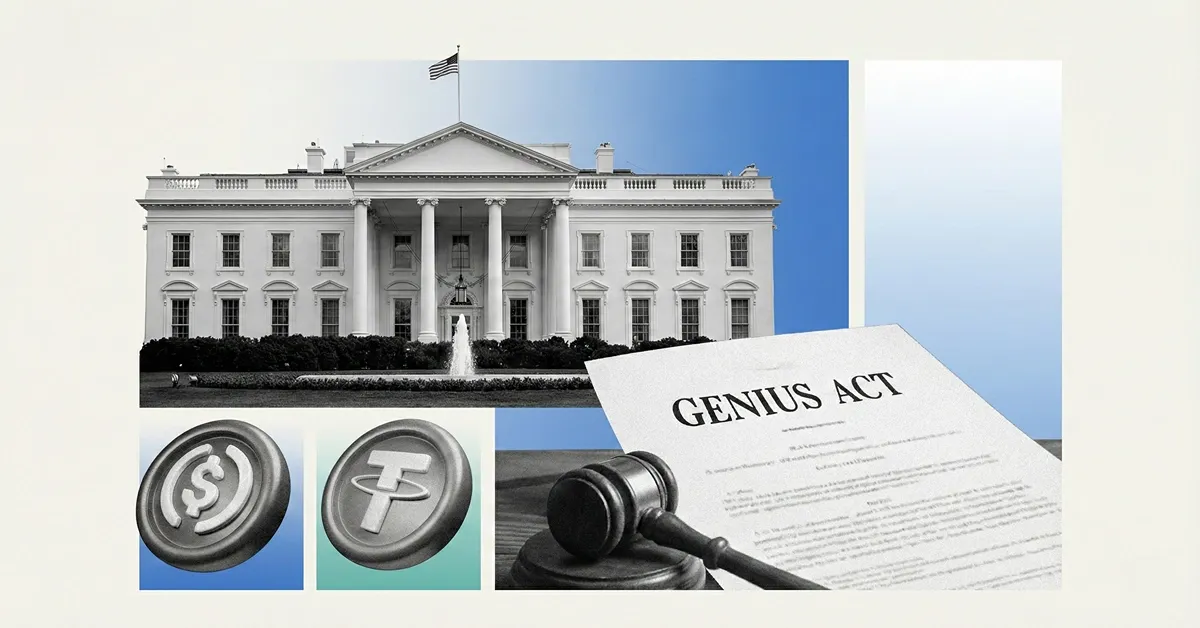
The GENIUS Act is now U.S. law, and it changes the stablecoin market in a way most people will only notice when listings and “cash-like” treatment start shifting. The key detail is a timer: by July 18, 2028, U.S. platforms face tighter limits on which stablecoins they can offer unless issuers meet the Act’s rules. That is why USDC has a clearer path inside the U.S. system, and why Tether’s U.S. strategy is starting to look like a split between global USDT liquidity and a separate U.S.-friendly product. Here’s what the law requires, what it bans, and the signals that will tell you who is winning before 2028 arrives.
That timer matters because the law creates a “permitted” path for payment stablecoins, then gives U.S. platforms a deadline to align with it. The effective cliff is three years after enactment, which points to July 18, 2028 in the Public Law 119-27 text.
You do not need to predict the future to trade this. You just need to understand what the law forces stablecoin issuers and U.S. platforms to do next.
Stablecoins are one slice of U.S. crypto regulation. For the broader map going into 2026, read US Crypto Regulation 2026: SEC, CFTC, Stablecoins, Taxes.
Market structure proposals like the CLARITY Act aim to define when a token is a digital commodity and how venues register. Our CLARITY update tracks the timeline heading into 2026: CLARITY Act timeline slips to 2026.
If you hold USDC
USDC fits the direction the GENIUS Act pushes toward: clear reserve rules, recurring disclosures, and a structure regulators can supervise. Circle is leaning into that lane with its OCC national trust bank charter effort tied to USDC infrastructure, backed by the OCC decision letter.
If you hold Tether
Tether still dominates global stablecoin liquidity, and that daily liquidity edge will not vanish overnight. What changes is U.S. distribution risk over time because foreign issuers face specific gates in the GENIUS Act bill text on Congress.gov. As 2028 gets closer, U.S. platforms get a strong reason to favor “permitted” coins.
Now let’s get concrete. Three rules drive most of the impact.
The three GENIUS Act rules that reshape the stablecoin market
1) 1:1 backing with tight reserve rules
The GENIUS Act requires payment stablecoins issued by permitted issuers to be backed at least 1:1 by eligible reserves. The reserve list steers issuers toward cash-like assets, including short-dated Treasuries. One detail does real work here: Treasuries qualify when remaining maturity is 93 days or less, spelled out in the public law.
Why you should care: short duration makes redemptions easier during stress. It reduces the odds that an issuer has to sell risky assets into a falling market.
2) Monthly reserve disclosures that are easy to compare
The law does not stop at “hold reserves.” It forces public reporting.
Permitted issuers must publish monthly reserve composition and other details, including average tenor and where reserves sit, described in the public law. That creates a new baseline for trust in the stablecoin market because readers can compare issuers without guessing.
Why you should care: better disclosure cuts through marketing. It also raises the cost of hiding risk.
3) A ban on issuer-paid yield for holding the stablecoin
This rule changes stablecoin product design.
The GENIUS Act bans permitted issuers from paying interest or yield to holders just for holding or using the stablecoin, laid out in the public law.
Why you should care: yield demand will not disappear. It moves into wrappers like tokenized T-bills, lending products, exchange programs, or other structures. The stablecoin itself gets pushed closer to “cash.”
Those three rules set the stage. The real plot is the timeline.
The 2028 clock that forces platform behavior
The GENIUS Act restricts U.S. platforms from offering or selling payment stablecoins unless they come from a permitted issuer or qualify under the foreign issuer pathway. The timing is tied to enactment, which is why July 18, 2028 becomes the market’s practical pressure point in the public law.
There is a second pressure point that matters to big firms: the law also says a non-permitted payment stablecoin should not be treated like a cash equivalent for key uses, stated in the public law. That pushes platforms toward coins that pass legal and audit review, not just coins with the most trading pairs.
The foreign issuer gate and the “lawful order” test
Tether and other foreign issuers are not automatically blocked. They face a gate.
A U.S. platform cannot make available a foreign-issued payment stablecoin unless the issuer can comply with lawful orders tied to freezing, blocking, or stopping transfers, described in the GENIUS Act text.
This turns compliance tooling into a business requirement. It is no longer a debate. It becomes a listing decision.
The next fight happens in rulemaking
The statute sets the frame. Agencies fill in the details.
Treasury opened implementation work through a public process in the Federal Register notice on GENIUS Act implementation. This is where edge cases get decided, including how foreign regimes are evaluated and what practical expectations platforms will apply before 2028.
If you want to front-run the stablecoin market shift, watch the rulemaking language, not the headlines.
Why USDC has a cleaner path in the U.S.
USDC gains because it can ride the “permitted” lane with less friction.
Circle’s strategy points in one direction: reduce legal uncertainty and deepen U.S. financial integration. The company’s OCC trust charter announcement and the supporting OCC decision letter are a direct signal that USDC wants to be the default compliant dollar in the U.S. stablecoin market.
This does not mean USDC wins everywhere. It means USDC gets a structural tailwind inside U.S. rails.
What the GENIUS Act means for Tether
Tether still has scale and liquidity, and that matters in global crypto markets. The pressure point is U.S. access over time.
One clear response is product separation. Reuters reported that Tether announced a new U.S.-based stablecoin called USAT after the GENIUS Act, framed as a way to build U.S. market presence while keeping USDT’s global role in place in the Reuters report.
This is the most logical play under the law: USDT remains the global liquidity tool. A separate U.S. product aims to satisfy the “permitted” lane, either directly or through partnerships.
That is how the stablecoin market can split into two lanes without breaking the dollar peg story.
The stablecoin market is big enough for this to matter
Stablecoins are not a side feature anymore. CoinGecko’s data shows stablecoins as a major segment of crypto market value, visible on CoinGecko’s stablecoin category pages and broader market charts like CoinGecko charts. When a segment that large gets a U.S. legal rulebook, platforms and payment firms adapt fast.
Five signals to watch between now and 2028
- Listing language on major U.S. platforms. Watch for “permitted” framing tied to the GENIUS Act in the public law.
- Treasury implementation details. Track updates through the Federal Register GENIUS Act docket.
- Monthly reserve reporting quality. The public law sets a baseline, and issuers will compete on clarity.
- Yield moving into wrappers. The issuer-paid yield ban lives in the public law, so the market will route yield around it.
- Foreign issuer compliance posture. The lawful order requirement is defined in the GENIUS Act text, and platforms will treat it like a risk filter.
GENIUS Act does not end stablecoins. It forces a U.S. compliant lane, and it puts a real date on when platforms must take that lane seriously. USDC is moving to sit inside that system. Tether looks set to defend global liquidity while building a separate U.S. path. The stablecoin market will not flip in a week, but incentives already shifted.
Stay up to date
Get the latest crypto insights delivered to your inbox
Primary sources and further reading
| Source | Title |
|---|---|
| | White House — Fact sheet: President Donald J. Trump signs GENIUS Act into law |
| | Congress.gov — Public Law 119-27 (GENIUS Act) PDF |
| | Congress.gov — S.1582 text (GENIUS Act) |
| | Federal Register — GENIUS Act implementation |
| | Circle — Conditional approval from OCC for national trust charter |
| | OCC — Decision letter |
| | Reuters — Tether unveils USAT stablecoin to boost U.S. market presence |
Fact-checked by: Daily Crypto Briefs Fact-Check Desk
Frequently Asked Questions
What does the GENIUS Act require for payment stablecoins?
It sets a permitted-issuer framework that requires at least 1:1 backing with eligible reserves, recurring public reserve disclosures, and other compliance and supervision requirements for payment stablecoins offered through U.S. platforms.
Why does the law create a “2028 clock” for stablecoins?
The Act phases in restrictions that push U.S. platforms toward payment stablecoins issued by permitted issuers or qualifying foreign issuers, creating a practical deadline for listings and distribution decisions as the three-year window closes.
Does the GENIUS Act ban stablecoin yield?
It bars issuer-paid interest or yield for simply holding or using the stablecoin, which pushes yield demand into wrappers like tokenized Treasury products, lending, or other structures rather than the stablecoin itself.
How could this affect USDC vs. Tether on U.S. platforms?
USDC is positioned to align with the permitted-issuer lane and disclosure expectations, while Tether and other foreign issuers face additional gating requirements that can influence listing and distribution over time in the U.S.