 Daily Crypto Briefs



WASHINGTON, November 4, 2026
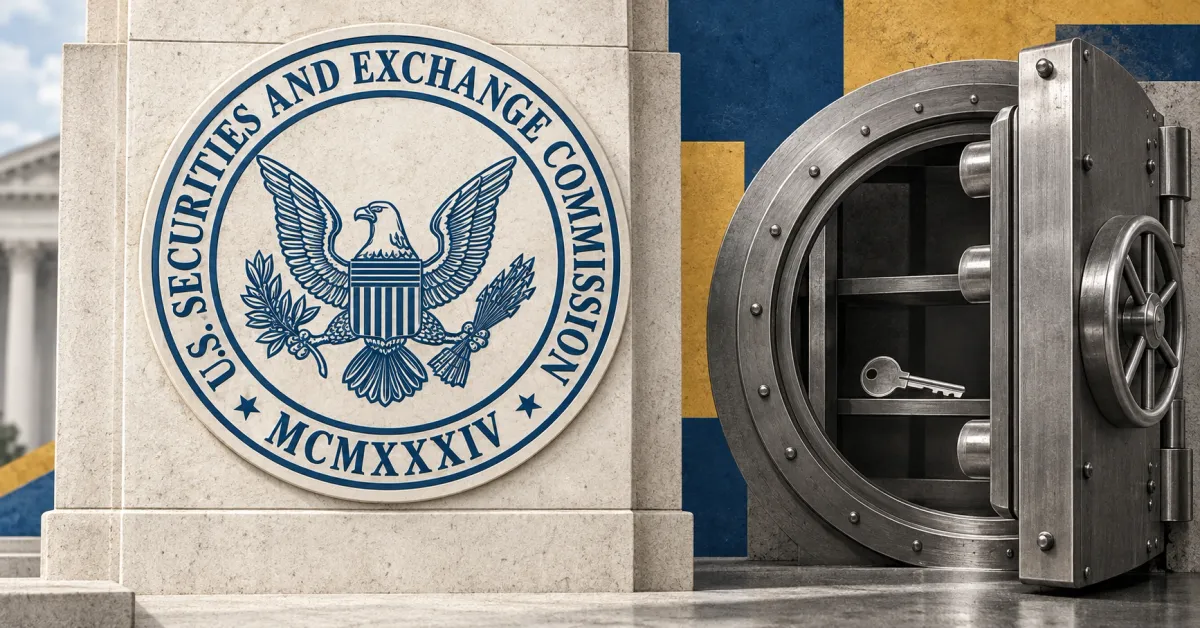
U.S. Securities and Exchange Commission staff said it views Canton Coin as a digital commodity in a November 3 letter, offering conditional relief for programmatic minting as CC’s completed daily session showed a 3.377% gain.
The Division of Corporation Finance response concerns coins created by Super Validators, Validators and application providers. It provides a specific enforcement position for network participation rather than a general approval of products built on Canton.
ChartExchange’s CC historical table showed a November 3 close of $0.0970, with a $0.0938 to $0.0977 range. That close was below the October 4 reading of $0.1295. These are provider-reported session figures, not proof that the letter caused the daily move or a measure of all global trading volume.
Canton Coin
CCCanton Coin letter narrows minting uncertainty
In its published response, staff relied on representations that CC’s value comes from network operation and supply and demand, and that Canton lacks a central controlling party. The response followed counsel’s October 30 request.
The enforcement position covers minting under the described conditions without registration under Section 5 of the Securities Act or Section 12(g) of the Exchange Act. Staff explicitly reserved the possibility of a different conclusion if the facts change and said the response supplies no legal conclusion.
Canton’s Global Synchronizer documentation explains the underlying service as infrastructure connecting independent applications while retaining controls over transaction visibility. Organizations operating Super Validators coordinate the shared infrastructure through on-chain governance.
CC pays for using that service and can be minted by participants providing utility. The relevant distinction is between an operator earning tokens through network work and an investor simply purchasing exposure to the token price.
For infrastructure businesses, the practical implication is a clearer staff position around compensation for operating the network. It does not remove operating expenses, token-price exposure or the need to establish that an actual arrangement matches the facts submitted.
SEC governance guidance focuses on control
The letter arrives one day after the division updated its crypto-asset FAQs. Those answers distinguish broad participation in governance from coordinated control and describe functionality and decentralization as separate concepts.
Under the November 2 guidance, unaffiliated participants generally are not treated as a controlling group solely because they join the same broad governance system. Separate agreements to act together, including delegation arrangements, remain relevant to the analysis.
The FAQs also identify unilateral powers that can indicate control, including deciding network access, changing voting processes and reversing transactions. They expressly describe staff views rather than new law. A project’s governance label alone therefore cannot establish how the framework applies.
Canton describes its shared service as using a two-thirds majority consensus mechanism and majority governance voting. Those operational arrangements help explain the focus on control; they do not turn every participant or application into an identical regulatory case.
The broader framework dates to the SEC’s March 17 crypto-assets interpretation, effective March 23. The sequence matters: the interpretation supplies the framework, the FAQs explain staff’s approach, and the Canton response applies it to particular representations.
This follows earlier token-specific staff responses for DoubleZero and Fuse, listed on the SEC’s crypto-assets resource page. A sequence of letters offers comparisons, but each project’s mechanics and submitted facts still require separate examination.
CC utility differs from tokenized stock ownership
Digital Asset’s July 2024 Canton Coin paper describes rewards for infrastructure and application providers, optional payments for network use and fees removed through burning. It records the Global Synchronizer’s mainnet launch in June 2024, placing the utility design well before this week’s letter.
The paper also explains that users can arrange for third parties to provision traffic balances. An institution can therefore consume network services through an intermediary rather than every end user directly managing CC. Institutional asset activity and demand to hold the token are related through those operating arrangements, not interchangeable measurements.
The site’s earlier coverage of Canton’s universal burn framework addresses a separate governance decision targeting implementation in 2027. That proposal concerns where production activity incurs burns; the SEC response concerns staff’s treatment of issuance. Neither establishes that burns will exceed newly created coins.
Likewise, Canton Strategic’s planned tokenized shares represent company equity with separate ownership records and access requirements. Holding CC does not confer those shareholder rights, and the minting letter does not establish permission for every securities venue or offering using the network.
Broader sentiment remained cautious. Alternative.me’s Bitcoin Fear and Greed Index read 34, or Fear, compared with 26 a day earlier when checked November 4. That indicator supplies market context rather than Canton-specific institutional demand.
Fear & Greed Index
Nov. 4, 2026The reviewed sources did not quantify new institutional activity attributable to the letter. The next substantive evidence would be disclosed operator adoption, application usage or additional regulatory action, alongside actual implementation of Canton’s separate economic proposals. The letter alone supplies neither a timetable for those developments nor a forecast for CC’s price.
Stay up to date
Get the latest crypto insights delivered to your inbox
Primary sources and further reading
| Source | Title |
|---|---|
| | SEC: Canton Coin no-action response, November 3 |
| | SEC: crypto-asset FAQs updated November 2 |
| | Canton: Global Synchronizer |
Fact-checked by: Daily Crypto Briefs Fact-Check Desk
Related Articles



Frequently Asked Questions
Did the SEC approve Canton Coin?
Staff issued a conditional no-action position, not a binding legal ruling or investment endorsement.
Who receives the Canton minting relief?
The response concerns Super Validators, Validators and application providers minting under the submitted circumstances.
Does holding CC mean owning tokenized shares?
No. Canton Coin is the network utility asset; tokenized company shares have separate ownership rights and access rules.
Does the letter change Canton Coin supply?
It does not announce a protocol upgrade. Issuance, fee burns and governance implementation determine the token's supply mechanics.