 Daily Crypto Briefs

NEW YORK, Jan. 27, 2026
About 60% of the 25 largest U.S. banks by assets are offering or developing Bitcoin products, according to a River analysis, as bitcoin traded around $88,900 on Tuesday. The River tally put the count at 15 of the top 25 banks offering, launching, or exploring Bitcoin custody or trading, a shift that would put crypto access closer to where many U.S. customers already keep their money.
Bitcoin changed hands near $88,927, up about 1.1% over 24 hours, with about $43.6 billion in 24-hour trading volume. The total crypto market cap stood near $3.06 trillion and bitcoin’s share was about 57.4%.
Bitcoin (BTC) price: 7-day snapshot
BTCOne of the clearest bank datapoints came from PNC, which said that it launched direct bitcoin access for certain clients through Coinbase’s Crypto as a Service. PNC Chief Executive Bill Demchak said, “As client interest in digital assets continues to grow, our responsibility is to offer secure and well-designed options.” (PR Newswire)
The River tally lands after a two-year stretch in which banks largely steered customers toward exchange-traded products or indirect exposure while waiting on clearer U.S. supervisory posture. On Sept. 3, 2025, U.S. Bank said it resumed cryptocurrency custody services for institutional investment managers, citing demand and “increasing regulatory clarity” (U.S. Bank).
Taken together, the moves point to a pragmatic buildout: banks can add custody, brokerage-style buying, and collateralized credit without rewriting the core deposit business. That can widen access for customers who will not open accounts on crypto exchanges, while keeping risk controls and reporting inside existing bank stacks.
River’s “top 25” list and what counts as Bitcoin products
River described its count as covering the top 25 U.S. banks by assets, with entries that were “offering, launching or exploring” bitcoin custody and trading, according to the outlets citing the analysis. The firm did not immediately disclose a full methodology in the reports, and it was not immediately clear which services were live for retail banking customers versus limited channels.
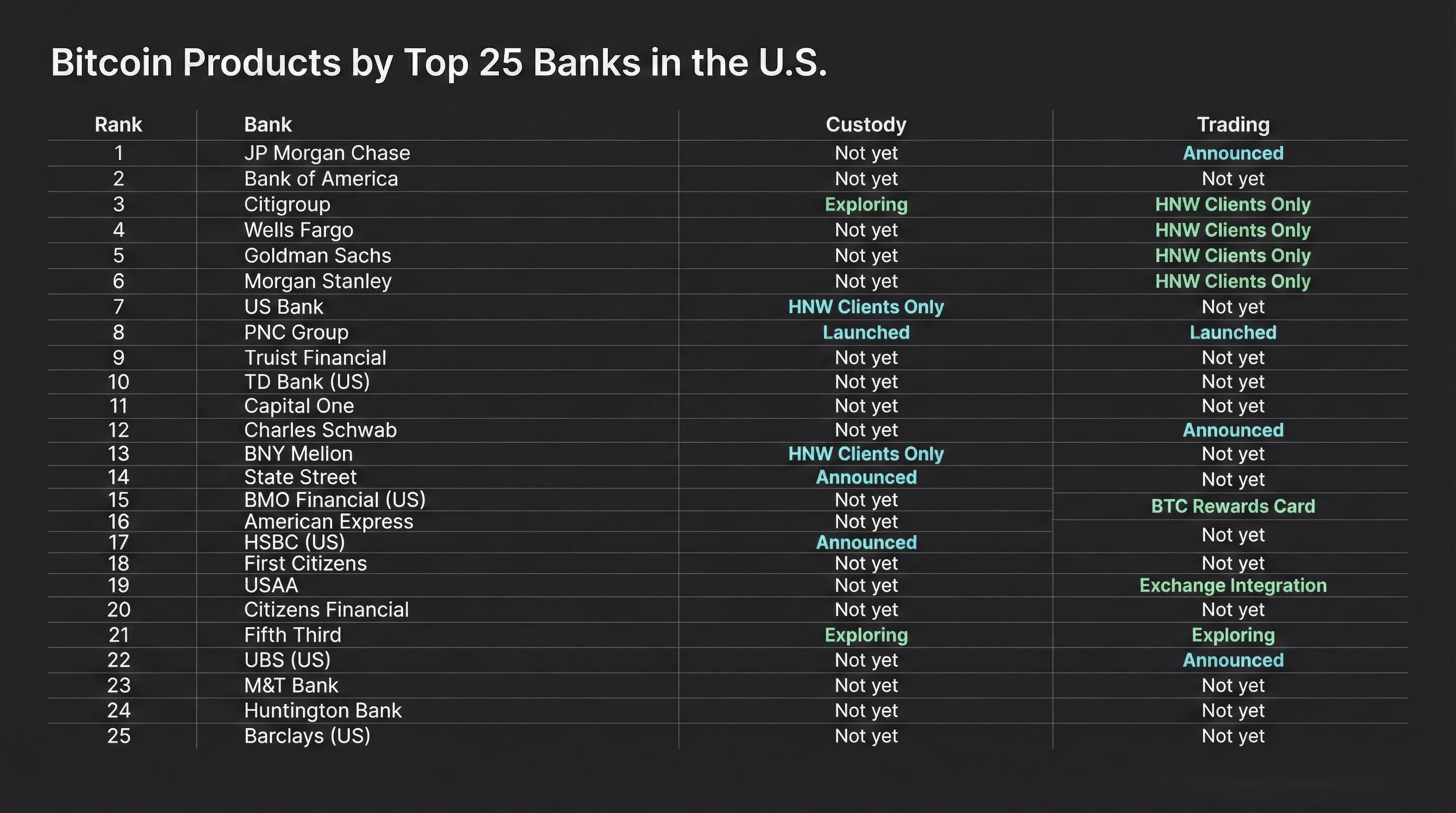
Even when a bank says it “offers bitcoin,” access can be gated by account size, geography, and product wrapper. A custody program for fund clients can look nothing like a buy-and-sell feature inside a consumer banking app.
In bank terms, “Bitcoin products” can mean several different things, even when the word “bitcoin” appears in the same sentence.
Custody is the back-office function of holding assets on behalf of clients, similar to how a bank or trust company safekeeps stocks and bonds. Trading access can be built as a brokerage feature where the bank routes orders to a partner or market maker, rather than taking crypto positions onto its own balance sheet.
For banks, the distinction matters because it changes which risks are being managed. Holding bitcoin for clients raises operational and security questions around key management, audits, and insurance, while routing trades pulls in consumer disclosures, partner oversight, and surveillance for market abuse.
Bitcoin-backed lending is a separate product, where a client posts bitcoin as collateral to borrow dollars. Several market observers point to this as a way for banks to meet demand from high-wealth customers without asking them to sell, though details and risk limits vary and are not always public.
For readers tracking the broader banking shift toward crypto rails, the push into bitcoin is arriving alongside stablecoin experimentation. Our reporting on Banks Are Coming for the Stablecoin Market outlines how banks are trying to keep payments and deposits from drifting to token-based alternatives.
How banks are packaging Bitcoin custody and trading for clients
The public disclosures so far suggest most rollouts are not mass-market offerings. They are being routed through private bank, wealth, and fund-services channels where client onboarding, suitability checks, and operational controls already exist.
PNC’s announcement is a useful case study because it spells out the distribution model: a bank-branded offering, powered by a crypto-native partner. PNC said private bank clients and other eligible customers could buy, hold, and sell bitcoin through the service, with Coinbase providing custody and trading infrastructure, per the release carried by PR Newswire.
U.S. Bank’s custody decision points to another slice of the market. The bank said it was serving institutional investment managers and their funds, a segment that tends to care less about app features and more about audits, reporting, and segregation of assets, according to the bank’s statement.
Other large banks have signaled interest without turning it into a broad product launch. JPMorgan’s chief executive said the bank planned to allow clients to buy bitcoin, while noting the bank would not custody the asset, according to Investopedia. Citigroup’s chief executive told CNBC the bank was looking at custody and stablecoin-related work, according to CoinDesk.
If you are trying to map the policy and product pipeline, our guide to US Crypto Regulation 2026 breaks down how agencies, Congress, and bank supervisors intersect for crypto activities.
U.S. supervision is shaping the pace of bank Bitcoin rollouts
The bank shift is not just a story about demand. It is also a story about process. In March 2025, the Office of the Comptroller of the Currency, the Federal Reserve, and the FDIC issued a joint statement on crypto-asset risks, a document that set expectations for governance, risk management, and legal compliance (OCC).
The same day, the OCC issued Interpretive Letter 1183, which said certain crypto-asset activities described in prior OCC letters were permissible for national banks when they are conducted in a safe and sound manner. For bank product teams, that sort of language can turn a stalled pilot into a scoped project with defined controls.
Weeks later, the FDIC said it rescinded a 2022 letter that had required FDIC-supervised banks to provide notice and receive non-objection before engaging in crypto-related activities, in a March 28, 2025 release (FDIC). The practical effect is that banks can move from “can we” to “how do we” more quickly, even if the risk bar stays high.
Congressional market-structure work also sits in the background for banks deciding what to build and when. Daily Crypto Briefs has tracked that timeline in CLARITY Act timeline slips to 2026 and in SEC chair signals crypto market structure bill is close, including what the bills may mean for custody, broker rules, and disclosures.
What remains unclear is how far banks will take these products beyond high-wealth and fund channels, and how quickly bank apps will converge with exchange-style features. Watch bank earnings calls and risk disclosures for specific rollout dates, partner names, and limits on custody, trading, and secured lending.
Stay up to date
Get the latest crypto insights delivered to your inbox
Primary sources and further reading
| Source | Title |
|---|---|
| | PNC: Direct Bitcoin access for clients (Dec. 9, 2025) |
| | U.S. Bank: Resumes crypto custody for fund clients (Sep. 3, 2025) |
| | OCC: Interpretive Letter 1183 (Mar. 7, 2025) |
| | FDIC: Rescinds FIL-16-2022 for crypto activities (Mar. 28, 2025) |
| | River: Bank bitcoin product snapshot |
Frequently Asked Questions
What does it mean when a bank offers Bitcoin custody?
Custody means the bank or a partner holds bitcoin on behalf of a client and handles safekeeping, reporting, and operational controls. It is closer to how banks safekeep securities than to running a trading desk.
Are these Bitcoin products available to everyday retail bank customers?
Often not. Public disclosures and bank statements cited in reporting suggest many rollouts are limited to private banking, wealth, and fund-services channels, and it was not immediately clear which banks offer app-based retail access.
Why are U.S. banks building Bitcoin trading and custody now?
Banks have pointed to client demand and shifting U.S. supervisory posture. Moves such as the OCC’s and FDIC’s 2025 updates have lowered process friction for certain crypto activities while keeping expectations for risk management in place.
Does bank custody change the risks for Bitcoin buyers?
It can shift the operational model. Some customers prefer a bank or bank-partner custody setup for audits and reporting, while others still opt for self-custody where they control the private keys and take responsibility for security.
Does FDIC insurance cover Bitcoin held through a bank?
FDIC insurance generally applies to insured bank deposits, not to the market value of bitcoin. If a product includes cash balances, the insurance treatment depends on how it is structured and was not disclosed in the cited reports.