 Daily Crypto Briefs





CASABLANCA, Aug. 15, 2026
Bitcoin’s BIP-110 monitor showed a 909-block rejected standard branch with zero observed bit-4 signals Saturday, crossing the 900-block mark less than a day after the branch stood at 814, as BTC traded near $63,023. At the 08:40 Casablanca-time check, the monitor listed its standard Bitcoin node at block 962,540 and its BIP-110-enforcing node at 961,635, a 905-height difference.
The reading is a material escalation from Daily Crypto Briefs’ 814-block BIP-110 update. The standard-chain side added 95 blocks, or about 11.7%, while the enforcing node did not advance. That makes this a threshold update rather than a routine refresh, though it remains an observation of two monitored nodes, not a Bitcoin-wide operational event.
The BIP110 Situation Monitor classified the standard history as a valid rejected fork under its enforcing node’s rules. mempool.space’s public record for block 962,540 matched the standard node’s reported tip hash when checked, independently confirming the standard-chain side of the snapshot.
The immediately verifiable metrics are the 909 rejected blocks, the 905-height gap and zero observed signals across the monitor’s 909 scanned headers. Kraken’s Bitcoin market page listed BTC at about $63,023 when checked, with the prior daily close near $62,979. The node readings do not show that this divergence caused the move.

Bitcoin
BTCThe monitor’s signaling scan displayed 909 consecutive standard-chain headers without version bit 4, the deployment bit named in the BIP-110 specification. The proposal describes a temporary consensus rule set intended to limit several data-carrying constructions.
That record has clear limits. It identifies what the dashboard’s two nodes and the inspected standard-chain block headers reported at one point. It does not determine the position of every mining pool, node operator, exchange, wallet, custodian or payment firm.
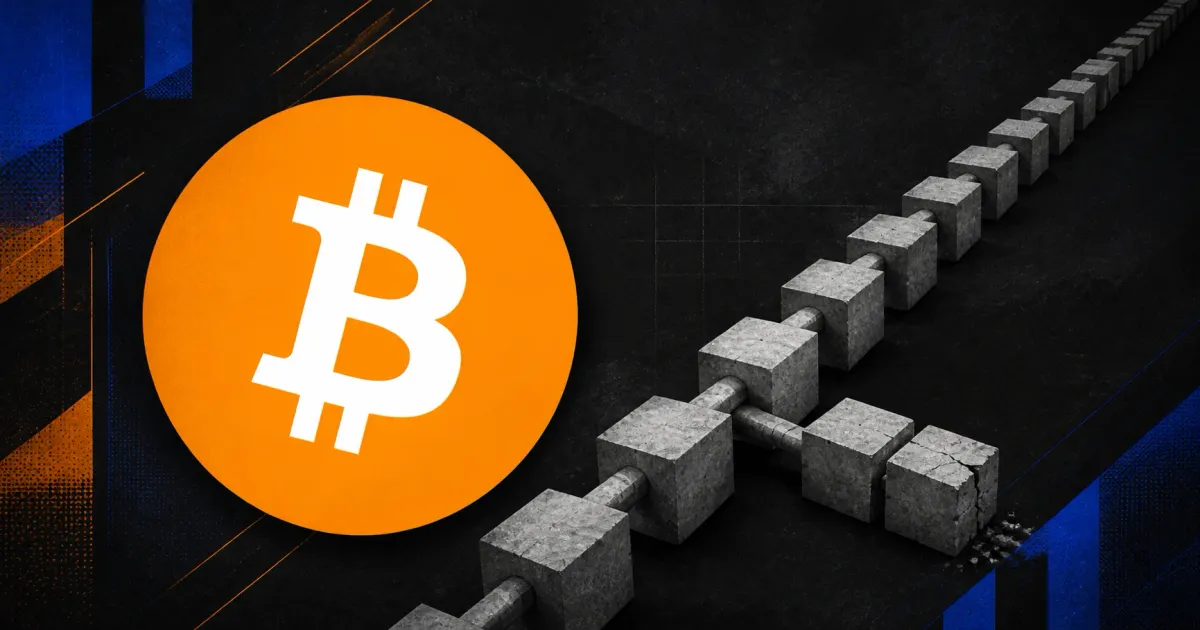
Bitcoin BIP-110 Fork Passes 900 Rejected Blocks
The 909-block number measures the standard Bitcoin history that the BIP-110-enforcing node rejects. It is not the same thing as the 905-height difference between the tips, because the two histories can share blocks after the mandatory-signaling height before they stop agreeing.
That distinction prevents a common overstatement. A node enforcing one set of validation rules can reject a growing history while conventional Bitcoin nodes continue to accept and extend it. The monitor’s status was “diverged,” not a declaration that one history has become universally accepted by Bitcoin users.
The updated branch grew by 95 blocks from Friday’s 814-block snapshot and cleared the next visible round-number threshold. It is a measurable change in the monitored split, but it does not prove that a larger share of Bitcoin’s economic infrastructure has changed chains.
The monitor showed its enforcing node fixed at 961,635, three blocks above BIP-110’s stated mandatory-signaling height of 961,632. The standard node’s tip had reached 962,540. The dashboard labeled the 909-block history “valid-fork,” an important qualifier: it is valid to the standard node it observes and rejected by the BIP-110 node it observes.
The BIP-110 text calls the proposal a Reduced Data Temporary Softfork. Its stated rules would temporarily place new consensus limits on selected output scripts, data pushes, witness items and certain Taproot constructions, while grandfathering UTXOs created before activation.
Zero Bit-4 Signals Remain BIP-110’s Key Test
The zero-signal reading is the most direct short-term datapoint. None of the 909 standard-chain headers displayed by the monitor carried bit 4. That means the inspected headers lacked the proposal’s deployment signal; it does not reveal every miner’s preference or substitute for a formal statement from a pool.
The dashboard’s list of 16 mining-pool labels included Foundry USA, AntPool, F2Pool, OCEAN, ViaBTC, SpiderPool, Luxor, MARA Pool, Binance Pool and Braiins Pool. It reported zero signals for each listed group in this scan. Those labels are block attributions on the monitor, not governance declarations from those organizations.
Bitcoin consensus changes are not settled by a single public vote. Software adoption, validation rules, block production and service-provider policies all affect the practical result. The inspected signaling string supports one narrow statement: the standard-chain headers in this monitored window did not contain BIP-110’s bit.
The proposal itself states a no-later-than lock-in height of 963,648 and a proposed activation height of 965,664. As Daily Crypto Briefs explained in its BIP-110 activation countdown, those heights are terms in the proposal, not confirmation that the standard chain has locked in the rules or that they are active across Bitcoin services.
The branch’s growth without a new signal makes the near-term issue more about continued node disagreement than a confirmed change in the activation result. A new bit-4 header, a new enforcing-chain block or public guidance from a major operator would be a more informative next development than another ordinary standard-chain block.
Bitcoin Services Show No Broad Migration Signal
No public evidence reviewed for this update showed a general instruction from a major exchange, custodian, wallet provider or payment processor to move normal BTC balances. The standard-chain tip remained publicly visible through an independent explorer, and the monitor did not report a general Bitcoin payment outage.
That leaves a narrow conclusion. The tracked divergence is a technical observation, not a notice that ordinary holders have different balances or need to take action. A service choosing a minority history would need controls for deposits, withdrawals, custody and chain selection, but no broad service-level migration was disclosed in the sources reviewed.
This development is separate from Bitcoin’s longer-running discussion about protecting old coins from possible future quantum-computing risks. The quantum-wallet rescue debate concerns a different proposal and does not direct holders to move BTC because of BIP-110.
The Crypto Fear & Greed Index read 34, or Fear, on Aug. 15, compared with 29 the day before. That sentiment measure is market context, not evidence that the BIP-110 divergence drove prices or investor behavior.
Fear & Greed Index
Aug. 15, 2026The next useful checks are specific: an enforcing-chain block beyond 961,635, a bit-4 signal in a standard-chain header, or public operating guidance from a major pool or service. Until then, the confirmed change is the 900-block threshold: a 909-block rejected standard branch, a 905-height difference and zero observed bit-4 signals in the monitor’s window.
Stay up to date
Get the latest crypto insights delivered to your inbox
Primary sources and further reading
| Source | Title |
|---|---|
| | Bitcoin BIPs: BIP-110 Reduced Data Temporary Softfork |
| | BIP110 Situation Monitor: Live |
| | mempool.space: Bitcoin block 962,540 |
| | Kraken: Bitcoin price and market data |
| | Alternative.me: Crypto Fear and Greed Index |
Fact-checked by: Daily Crypto Briefs Fact-Check Desk
Related Articles




Frequently Asked Questions
What changed in the latest BIP-110 fork update?
The BIP110 Situation Monitor's rejected standard branch rose from 814 blocks to 909, passing the 900-block threshold. The monitor still showed zero bit-4 signals across the scanned headers and the same BIP-110-enforcing node height of 961,635.
Does a 909-block BIP-110 branch mean Bitcoin has split for all users?
No. The reading shows two monitored nodes following different histories under different validation rules. It does not by itself show broad exchange, wallet, custodian, payment-provider or miner support for the shorter BIP-110 history.
Did any Bitcoin blocks signal BIP-110?
No. The monitor's scanned 909-block signaling string contained zero bit-4 signals at the time checked. That is an observation about the headers in its window, not a formal vote or a statement from every miner or node operator.
Do Bitcoin holders need to move BTC because of BIP-110?
No public evidence reviewed for this report showed a general instruction to move normal BTC balances, a broad payment outage or broad service suspensions on the standard Bitcoin chain.