 Daily Crypto Briefs
BRUSSELS, March 16, 2026
Public disclosures show that roughly 20 major European bank brands and banking groups are moving into crypto under MiCA, through live trading launches, custody buildouts, and stablecoin infrastructure projects, as Polymarket traders price an 84% chance that bitcoin finishes March above $75,000.
Will Bitcoin go over \$75K by end of March? Live

The banks that spent 2022 treating crypto as a compliance problem are now building ways to sell it, hold it, or settle around it for customers. Spain’s BBVA and Santander-owned Openbank already market crypto access, while Belgium’s KBC and German institutions including Commerzbank and DekaBank are moving deeper into distribution.
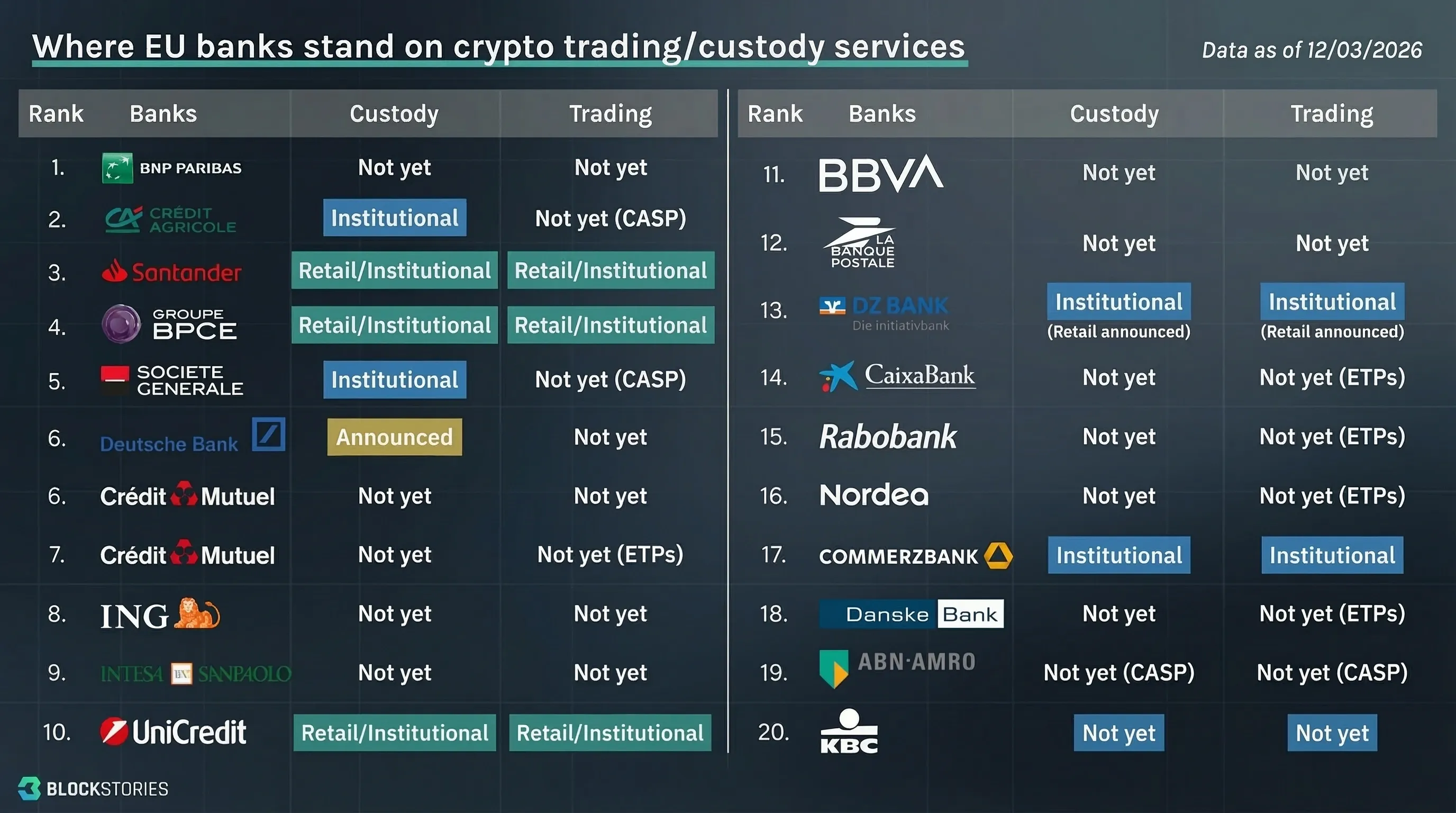
European bank crypto rollouts are no longer isolated pilots. They now span retail trading, custody, and stablecoin infrastructure.
Market Snapshot: Bitcoin traded near $74,084 early on March 16, up 5.09% from the previous close after ranging between $72,323 and $74,372. That leaves the March-over-$75K line close enough that the 84% betting-market probability looks more like a delayed response to distribution changes than a fully repriced view of them.
MiCA turns Europe’s banks into crypto distributors
The cleanest official signal came from BBVA, which said its Spain launch lets customers “buy, sell, and hold bitcoin and ether directly via the mobile app”. That matters because BBVA framed the service as part of a fully integrated banking environment rather than a side experiment, and tied it directly to the new MiCA framework.
MiCA did not make crypto safe, but it did give bank product teams a clearer legal lane. ESMA says the regime creates uniform EU rules for crypto-assets and crypto-asset service providers, a major change from the fragmented national caution that kept many large institutions on the sidelines during the last cycle.
The timeline shift is hard to miss. In 2022, many European customers ran into blocked transfers, bank warnings, or manual reviews when moving money to exchanges. By March 2026, Openbank says customers can buy and sell crypto in the same app they use for day-to-day banking, starting from as little as EUR 1 and without custody fees. KBC has launched regulated crypto trading through Bolero. Commerzbank already holds a crypto custody licence and positioned it as the foundation for a broader digital-asset stack.
Once crypto shifts from exchange tabs to bank apps, the user funnel changes. Demand can move through institutions that already own the cash balance, the identity checks, and the investment dashboard.
Retail crypto is moving from exchanges to bank apps
The “20 banks” claim is best understood as a mix of live launches, custody builds, and consortium bets rather than 20 fully mature retail products. Even so, the direction is unmistakable. DekaBank’s 2025 interim report said that after receiving licences for crypto securities register management and crypto custody in December 2024, it can now cover the digital asset value chain inside the Sparkassen-Finanzgruppe for savings-bank customers and institutional clients.
Sparkasse’s own public guidance goes a step further, stating that customers who still want to trade crypto will likely be able to do so through the Sparkasse app from 2026 using DekaBank products. That means the shift is no longer confined to niche crypto-native firms or private banking desks.
The same pattern is showing up outside Germany. UniCredit said it joined ING, Banca Sella, KBC, Danske Bank, DekaBank, SEB, CaixaBank, and Raiffeisen Bank International in a new euro stablecoin venture expected to target issuance in the second half of 2026. That is not a bitcoin trading app, but it shows large European banks no longer treat onchain money as optional infrastructure. It also fits with the fight over stablecoin rails, where banks are trying to keep payments and deposits from drifting to crypto-native platforms.
For readers tracking whether this is just a Europe story, it is not. We recently mapped how top American banks are adding bitcoin products, and Europe now looks like the faster-moving regulatory laboratory because MiCA gave banks a clearer rulebook earlier than many other large markets.
Stay up to date
Get the latest crypto insights delivered to your inbox
Primary sources and further reading
| Source | Title |
|---|---|
| | ESMA - Markets in Crypto-Assets Regulation (MiCA) |
| | BBVA launches its bitcoin and ether trading and custody service for all retail customers in Spain |
| | Openbank - Buy and sell cryptocurrencies on one single platform |
| | KBC Bank launches regulated crypto services with Crypto Finance as partner |
| | Commerzbank granted Crypto Custody Licence |
| | Deka Group Interim Report 2025 |
| | UniCredit - uniting with European banks to launch a stablecoin |
Fact-checked by: Daily Crypto Briefs Fact-Check Desk
Frequently Asked Questions
What does MiCA change for European banks that want to offer crypto?
MiCA gives crypto-asset service providers a harmonised EU framework for authorisation, disclosures, and conduct rules. That makes it easier for banks to launch services across Europe without relying on fragmented national approaches.
Which European banks already offer crypto trading or custody?
Public disclosures show live or active crypto moves from banks including BBVA, Openbank, KBC, Commerzbank, and Deka-linked Sparkassen channels, while other large groups are building stablecoin and digital asset infrastructure.
Why does bank adoption matter for Bitcoin demand?
Bank distribution can move crypto access closer to where customers already keep cash and investments. That reduces onboarding friction compared with opening and funding a separate exchange account.
Does MiCA mean crypto bought through a bank is risk free?
No. MiCA adds conduct, disclosure, and authorisation requirements, but Bitcoin and other crypto-assets remain volatile and can still expose buyers to market risk.
What does Bitcoin's 10 year chart suggest about the next decade?
The long-run chart suggests the debate is shifting from whether Bitcoin survives to how widely regulated institutions distribute it. The next phase may be shaped more by access and market plumbing than by basic legitimacy.