 Daily Crypto Briefs



CASABLANCA, June 16, 2026
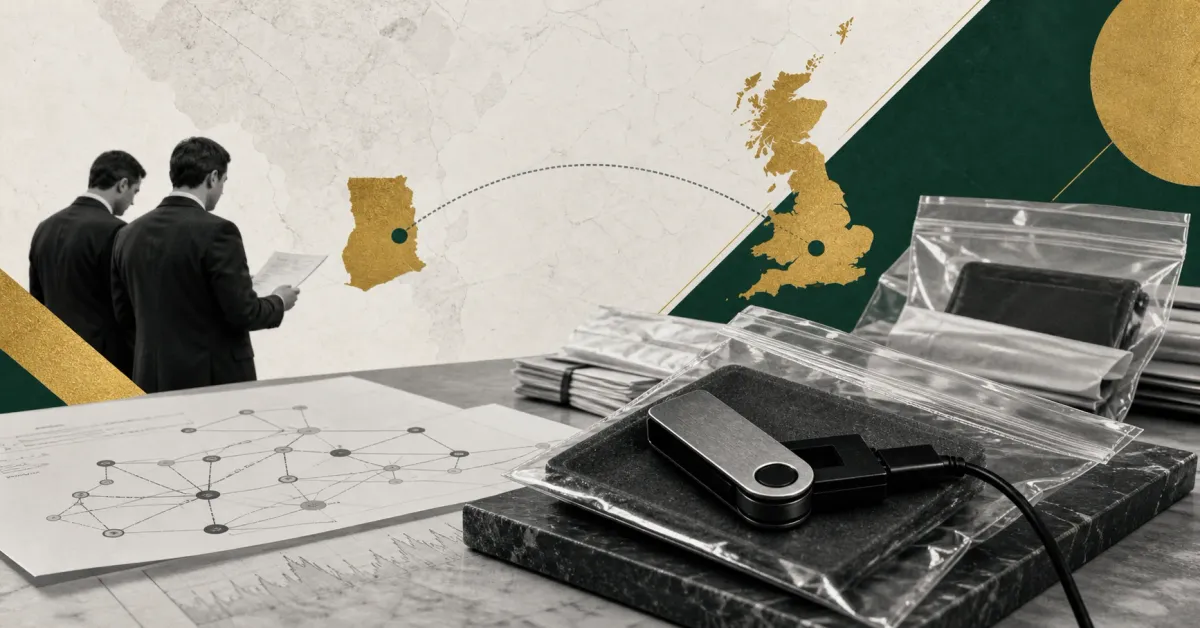
Ghana’s Economic and Organised Crime Office and the UK’s National Crime Agency are preparing roughly $15.1 million in seized crypto fraud proceeds for victim restitution after investigators traced funds tied to a Chinese-Malaysian investment scam network, Chainalysis said Tuesday.
The case centers on an e-commerce-style investment platform that promised online-shop returns, trading points and referral balances. Chainalysis said the operation instead siphoned funds from victims in Ghana and beyond, then laundered proceeds through cryptocurrency.
Market snapshot: investigators identified criminal proceeds equivalent to 119.4 BTC, 93 ETH and 2.85 million USDT, spread across nearly 20 coins and tokens. CoinGecko showed bitcoin near $65,699 on June 16, while the broader crypto market cap stood near $2.34 trillion.
Chainalysis said Ghana’s EOCO, Europol, the UK NCA and private-sector partners used blockchain analytics to identify, freeze and seize the funds. Matthew Perfect of the UK’s National Economic Crime Centre described the live evidence-sharing as “co-investigating,” according to the Chainalysis account.
The case follows a broader spring push against crypto-enabled scams. In April, the NCA said Operation Atlantic froze more than $12 million in suspected criminal proceeds and identified more than 20,000 victims across the UK, Canada and the United States.
The immediate signal is enforcement capacity. The strongest fraud cases are no longer just tracing exercises after money disappears. They increasingly depend on exchanges, analytics firms, court orders and victim-screening workflows that can move fast enough to preserve assets before the next laundering hop.
What remains unclear is when victims will receive funds, how EOCO will validate claims, how much will be repatriated to the UK and whether criminal cases against the alleged organizers will produce further asset recovery.

Bitcoin
BTCGhana EOCO Seizes Crypto Fraud Proceeds
The investigation began outside Ghana. Chainalysis said OKX compliance teams spotted unusual activity linked to an apparent investment scheme and reported it to Europol, which passed the case to the UK NCA.
NCA analysts then traced operational nodes back to Ghana, including a physical office fronting the alleged fraud and mule accounts receiving victim funds. The NCA international liaison officer in Accra referred the case to EOCO, combining traditional financial intelligence with early blockchain analysis.
Speed was central to the recovery. Chainalysis said EOCO used a 14-day administrative freeze power to stop relevant exchange accounts, then obtained a formal court order requiring the exchange to maintain the freeze while the investigation advanced.
That legal step is the difference between a dashboard finding and money victims might actually see again. A blockchain trail can identify where value moved, but an exchange freeze, court order and custody process decide whether the funds stay reachable.
The seized assets were later sold through private-sector partnerships with ComplyCrypto and Zodia Custody, according to Chainalysis. About $15.1 million was transferred into a dedicated exhibit account in Ghana, where EOCO is screening victims and designing the restitution process.
Some victims are British citizens, so part of the recovered money is expected to be repatriated to the UK. The timing and allocation method were not immediately disclosed.
Chainalysis Tracing Turns Wallets Into Evidence
The on-chain work mattered because the fraud did not sit in one wallet. Chainalysis said EOCO and NCA investigators used Reactor to cluster related blockchain addresses and map flows associated with the platform.
What initially looked like separate wallets and accounts became a single coordinated operation, according to the firm. Chainalysis later attributed the same cluster as a major investment scam in its broader dataset.
The asset mix shows how fraud operators try to blur the trail without leaving crypto entirely. Investigators identified proceeds equivalent to 119.4 BTC, 93 ETH and 2.85 million USDT, with funds spread across nearly 20 tokens and much of the value previously held in DOGE before consolidation.
That fragmentation is familiar to readers following exchange freezes and phishing investigations. Daily Crypto Briefs covered a smaller U.S. example when Coinbase froze more than $3 million during a DOJ-led Southeast Asia scam operation, but the Ghana case is more advanced because it has moved into a defined restitution phase.
It also shows why crypto fraud recovery now depends on records beyond the chain. EOCO obtained know-your-customer records from the exchange, Chainalysis said, linking wallet activity to named individuals and corporate entities, including alleged members of the Chinese-Malaysian organized crime group who had already fled Ghana.
For self-custody users, the lesson is not that every scam dollar can be retrieved. It is that the fastest path to recovery is usually early reporting, identifiable exchange touchpoints and clean evidence. Once funds move into mixers, cross-chain routes or offshore cash-out networks, victim recovery becomes materially harder.
Restitution Test Goes Beyond Operation Atlantic
The Ghana case fits a larger enforcement push against online investment fraud. UNODC says fraud is increasingly transnational and no single jurisdiction or sector can tackle it alone, which is exactly the gap crypto scams exploit.
The March INTERPOL-UNODC summit framed fraud as one of the fastest-growing forms of transnational organized crime, with global organized fraud and scam losses estimated at $442 billion by the Global Anti-Scam Alliance.
That makes a $15.1 million restitution process small in global terms but large as a proof point. It shows how a report from an exchange, a Europol handoff, UK analysis, Ghanaian legal powers, blockchain analytics and custody partners can form one recovery chain.
The user-level risk remains the same: investment platforms can look real until withdrawals fail. Scammers can promise shop income, referral points, artificial balances or managed trading returns, and none of those interface details prove that a real business exists behind the screen.
The same social-engineering layer also appears in wallet-drainer and fake-app cases, including the Ledger and Trezor phishing risks that turn ordinary users into direct signers of their own losses. Technical tracing helps after the fact, but prevention still starts before funds leave the wallet or exchange account.
Alternative.me’s Crypto Fear and Greed Index printed 23, classified as Extreme Fear, on June 16 as bitcoin stabilized from its early-June slide.
Fear & Greed Index
June 16, 2026The next evidence will be administrative and legal. Watch for EOCO’s victim-screening criteria, UK repatriation details, any public charging documents and whether Ghana uses the case to formalize faster crypto asset-freeze procedures for future fraud investigations.
Stay up to date
Get the latest crypto insights delivered to your inbox
Primary sources and further reading
| Source | Title |
|---|---|
| | Chainalysis: Ghana EOCO and UK NCA crypto fraud restitution case |
| | National Crime Agency: Operation Atlantic crypto fraud freeze |
| | UNODC: Global Fraud Summit 2026 |
| | INTERPOL: Global Fraud Summit call to action |
| | CoinGecko: Bitcoin price |
| | Alternative.me: Crypto Fear and Greed Index |
Fact-checked by: Daily Crypto Briefs Fact-Check Desk
Related Articles



Frequently Asked Questions
How much crypto fraud money was recovered in the Ghana and UK case?
Chainalysis said roughly $15.1 million was transferred into a dedicated exhibit account in Ghana after assets linked to the fraud were seized and sold.
Which agencies were involved in the crypto fraud recovery?
The case involved Ghana's Economic and Organised Crime Office, the UK National Crime Agency, Europol and private-sector partners including Chainalysis, ComplyCrypto and Zodia Custody.
What assets were traced in the Ghana crypto fraud case?
Chainalysis said investigators identified criminal proceeds equivalent to 119.4 BTC, 93 ETH and 2.85 million USDT, with funds spread across nearly 20 coins and tokens.
Have victims already received the $15.1 million?
Not yet. Chainalysis said EOCO is screening victims and designing a restitution process, with some funds expected to be repatriated to the United Kingdom.
Why is this case important for crypto enforcement?
It is a rare West Africa crypto-fraud case where blockchain tracing, asset freezes and cross-border cooperation are being used to move from scam detection toward victim compensation.