 Daily Crypto Briefs




NEW YORK, June 21, 2026
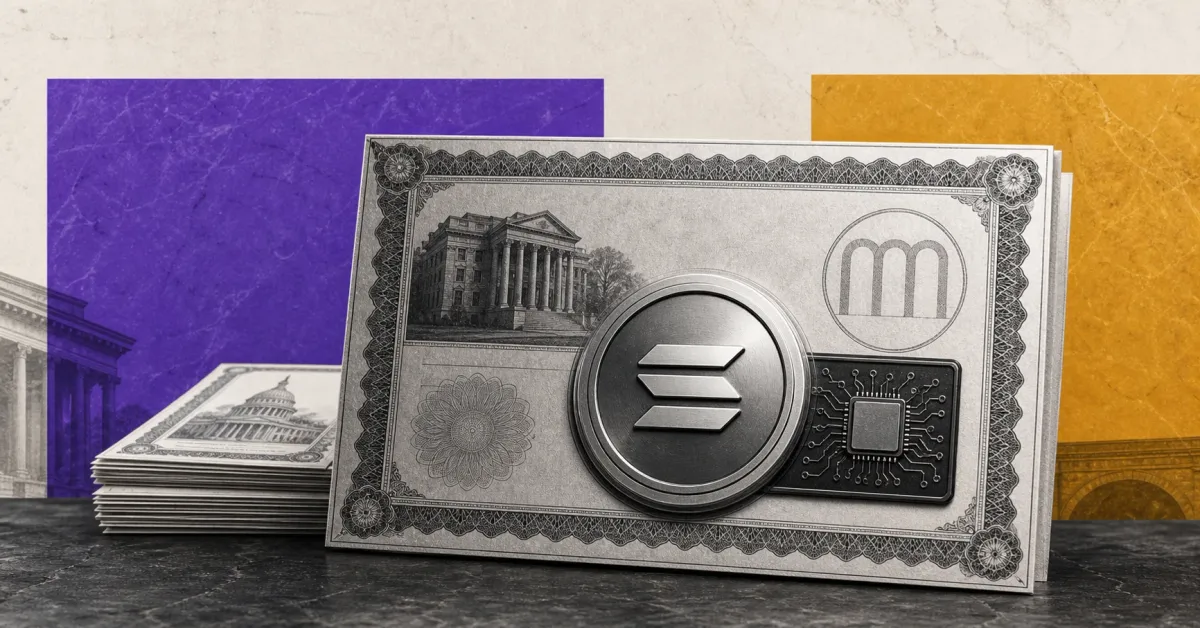
Moody’s has made its credit ratings machine-readable on Solana through Alphaledger, the first deployment of the ratings firm’s onchain data engine on a major public permissionless blockchain as tokenized fixed-income markets expand.
The integration allows issuers using Alphaledger to attach Moody’s ratings directly to eligible tokenized bonds and other fixed-income securities. Investors and software can then retrieve the credit signal from the asset’s blockchain infrastructure instead of relying only on a separate database or document.
SOL traded near $73.20 on June 21, up 5.46% from the previous day but about 14.9% below its May 21 level, according to YCharts historical data. RWA.xyz tracked approximately $2.5 billion of distributed real-world assets on Solana, up 7.34% over 30 days, across 420 assets.
Moody’s said in its official announcement that investors increasingly need independent credit analysis where they transact. Its Token Integration Engine, or TIE, was designed to work across different networks rather than remain tied to one blockchain.
The launch follows a June 2025 proof of concept on Solana’s devnet and Moody’s first production TIE deployment on the permissioned Canton Network in March 2026. Solana extends that system into an open network where asset data can be read by public-chain applications.
The change could make tokenized bonds easier for automated systems to screen, price and monitor, but it does not remove the need to review the issuer, legal claim, custody structure or full Moody’s rating analysis.

Solana
SOLPrice series compiled from YCharts’ Solana historical data.
Moody’s Ratings Become Onchain Data
Traditional credit ratings normally sit in reports, data terminals and licensed feeds. A tokenized bond may trade on a blockchain, while the information used to judge its default risk remains in a separate offchain system.
TIE is intended to close that gap. Alphaledger said in its deployment notice that issuers can choose to have Moody’s ratings pushed directly onto Solana when they tokenize fixed-income securities through its platform.
The rating can therefore travel with the asset as structured data. A portfolio system could identify rated securities, a compliance tool could flag a downgrade and a trading application could display the credit category without manually matching a token address to an external record.
That is a meaningful infrastructure change, but not an automatic trading instruction. Moody’s ratings express relative credit risk and can change. They do not assess every risk attached to a token, including smart-contract bugs, wallet controls, redemption mechanics and the enforceability of ownership claims.
The system also does not make all Solana assets Moody’s-rated. It applies only when a fixed-income issuer on Alphaledger has a Moody’s rating and elects to integrate it. SOL, memecoins and unrelated tokenized securities receive no Moody’s endorsement from the announcement.
The narrower scope distinguishes the launch from Solana’s broader RWA growth. Daily Crypto Briefs previously reported that Solana captured 97% of tokenized-equities spot volume in May, but equity trading share and fixed-income credit analysis solve different market problems.
Alphaledger Connects Bonds to Solana
Alphaledger is the bridge between Moody’s data and the blockchain asset. The company focuses on institutional fixed income, including municipal securities, where investors routinely use ratings to compare repayment risk across issuers.
Alphaledger Chief Executive Manish Dutta said the integration brings a credit language already used in conventional bond markets into tokenized assets without requiring a separate intermediary lookup. The company did not disclose the first security that will carry a live Moody’s rating through the production integration.
The absence of a named launch asset limits what can be measured today. The announcement establishes technical availability, but it does not disclose issuance value, investor count, secondary-market volume or how many issuers have committed to use the service.
Solana’s existing RWA base gives the integration a larger distribution surface than a stand-alone pilot. RWA.xyz placed Solana third among public networks by distributed asset value, behind Ethereum and BNB Chain, with an 8.09% market share at the time of publication.
Those figures include multiple asset classes and methodologies, not only rated bonds. They show that Solana already hosts a material tokenized-asset market, while the Moody’s integration adds institutional data infrastructure that could support fixed-income growth.
The contrast with Canton is also important. Canton is designed for regulated institutions that need transaction privacy and permissioned workflows. Daily Crypto Briefs covered how DTCC moved tokenized Treasury infrastructure toward Canton, reflecting the appeal of controlled networks for post-trade finance.
Solana is public and permissionless. That makes ratings easier to expose to wallets, analytics services and onchain applications, but it also increases the importance of verifying the authentic asset, data source and issuer-controlled contracts.
Tokenized Credit Still Needs Legal Clarity
Tokenization can make a bond transferable around the clock, yet the token is only one layer of the investment. The holder still depends on legal documentation defining the debt claim, the issuer’s ability to pay, custody arrangements and the process for interest, default and redemption.
A machine-readable rating may improve discovery and monitoring without resolving those dependencies. Smart contracts can react to a rating field, but they cannot determine whether the field is stale, whether a downgrade is contested or whether a token holder has the same rights as a registered owner in conventional market records.
The risk becomes more significant if DeFi protocols use rated securities as collateral. Automated lending markets could set borrowing limits or liquidation thresholds from credit data, creating faster risk controls but also concentrating reliance on an oracle, update process and rating methodology.
Institutional tokenization is moving beyond isolated demonstrations. Citi’s June Tokenization 2030 report estimated the current tokenized financial-asset market at roughly $17 billion and projected a $5.5 trillion base case by 2030, led by public fixed income and equities.
Moody’s expansion fits that transition from issuing tokens to supplying the data those assets need to function in regulated portfolios. JPMorgan’s tokenized money-market fund on Ethereum similarly showed that the institutional competition is increasingly about complete financial products rather than blockchain proofs of concept.
Broader market sentiment remained weak despite SOL’s daily rebound. Alternative.me’s Crypto Fear and Greed Index stood at 23, classified as Extreme Fear, on June 21.
Fear & Greed Index
June 21, 2026The next evidence to watch is a named rated issuance on Alphaledger, followed by data on issuance size, investors and secondary activity. Moody’s also said it plans to expand TIE to more digital-finance networks and instrument types, but it did not provide a timetable or identify the next blockchain.
Stay up to date
Get the latest crypto insights delivered to your inbox
Primary sources and further reading
| Source | Title |
|---|---|
| | Moody's Ratings: Token Integration Engine expands to Solana |
| | Alphaledger: Moody's credit intelligence goes onchain on Solana |
| | RWA.xyz global tokenized asset dashboard |
| | YCharts Solana historical price data |
| | Citi Institute Tokenization 2030 report |
| | Alternative.me Crypto Fear and Greed Index |
Fact-checked by: Daily Crypto Briefs Fact-Check Desk
Related Articles




Frequently Asked Questions
What did Moody's launch on Solana?
Moody's expanded its Token Integration Engine to Solana through Alphaledger. The system lets eligible tokenized fixed-income issuers integrate Moody's credit ratings into asset data recorded on the blockchain.
Does Moody's rate every token on Solana?
No. The integration applies to rated fixed-income securities tokenized through Alphaledger when an issuer chooses to include the rating. It is not a rating of Solana, SOL or every asset on the network.
Why are machine-readable credit ratings important?
Machine-readable ratings can be consumed directly by wallets, trading systems, compliance tools and smart contracts. That reduces reliance on separate offchain lookups, although investors still need the full rating rationale and underlying legal documents.
Is Solana the first blockchain used by Moody's Token Integration Engine?
No. Moody's first deployed the engine on the permissioned Canton Network in March 2026. Solana is the first major public permissionless blockchain in the rollout.
What is Alphaledger?
Alphaledger is a tokenization platform focused on institutional fixed-income assets. It is the integration partner connecting Moody's rating data with eligible assets issued on Solana.
Can a credit rating prevent a tokenized bond default?
No. A rating is an opinion about credit risk, not a guarantee. Tokenized bonds also carry legal, custody, liquidity, technology and smart-contract risks that a credit rating may not fully capture.