 Daily Crypto Briefs




TOKYO, July 14, 2026
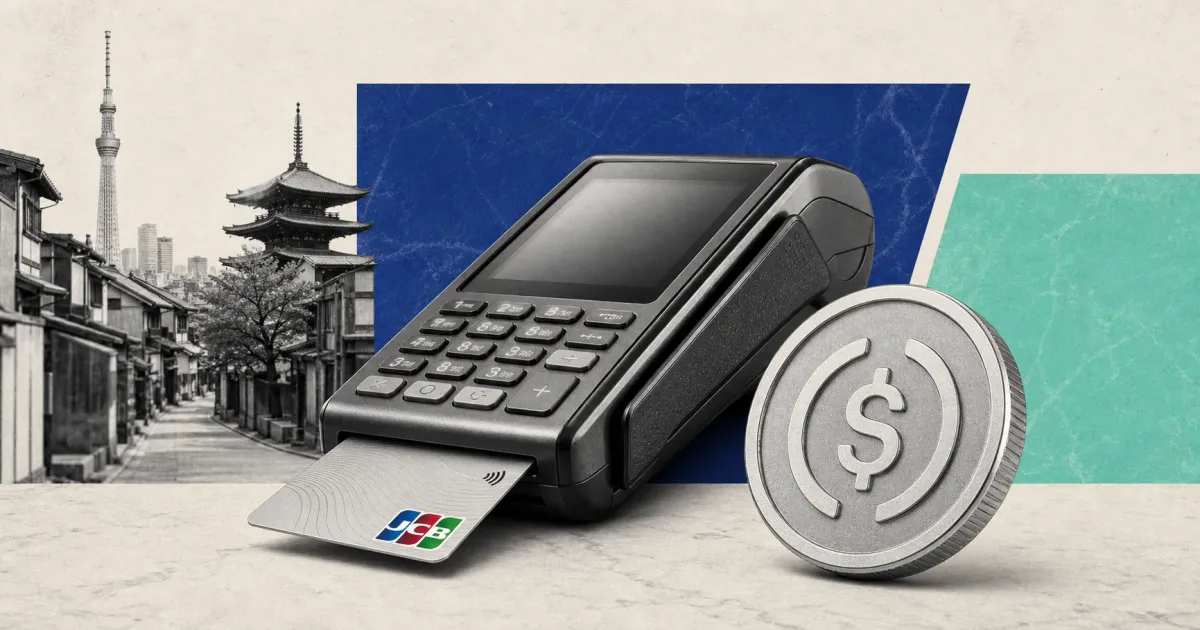
JCB has signed a memorandum of understanding with a Circle affiliate to explore USDC-based cross-border treasury transfers and stablecoin payments for Japanese merchants, putting a network of about 72 million merchants behind one of crypto’s biggest unlaunched payments experiments.
The agreement, announced Tuesday in Tokyo, is a framework for investigation rather than a consumer rollout. JCB and Circle did not name participating merchants, disclose transaction volumes or set a launch date for shoppers to pay with USDC.
USDC circulated at roughly $72.9 billion on July 14, according to CoinGecko market data, down from about $74.8 billion one month earlier. The token traded between $0.9995 and $1.00 over the previous 24 hours and between $0.9993 and $1.00 over seven days, while JCB said its network had more than 181 million cardmembers as of March.
In its announcement, JCB said the companies will explore combining Circle’s stablecoin payment infrastructure with JCB’s global merchant network to advance cross-border payments and create new payment experiences. The first work includes a possible proof of concept for JCB’s own internal fund transfers using USDC.
The move arrives as USDC is already expanding from trading venues into payment plumbing. Visa’s U.S. USDC settlement expansion showed banks can use the token behind card-network obligations, while the JCB arrangement aims first at treasury movement and then potentially at the merchant counter.

USDC
USDCCircle and JCB target USDC payment pilots
The announced scope has two parts. First, the companies will examine whether USDC can improve cross-border treasury and settlement flows, starting with a possible internal JCB pilot. Second, they will study stablecoin-based point-of-sale experiences for Japanese merchants and overseas visitors.
That wording is important. A memorandum is not an integration, and JCB did not say that a shopper can now tap a JCB card, scan a wallet or settle a purchase in USDC. It also did not disclose which blockchain networks, acquiring banks, wallet providers or compliance processes would support any eventual service.
For a treasury pilot, the relevant customer could be JCB itself rather than a cardholder. The company said it would consider USDC for internal cross-border fund transfers, a back-office use that can be tested before a retailer, acquirer or wallet is asked to change its checkout process. The release also refers to improving settlement efficiency and reducing transfer costs, but it gave no estimate of current costs, expected savings or the volume to be tested.
For merchants, the arrangement leaves open several different designs. A visitor might hold a stablecoin wallet while a shop receives yen, or USDC could be used only between financial intermediaries after an ordinary card purchase. JCB did not say which model it prefers, whether it would accept USDC directly at the point of sale, or how refunds and chargebacks would be handled. Those choices will determine whether the proposal is a visible consumer payment method or chiefly a settlement rail.
Circle says USDC is natively supported on 34 blockchain networks and is designed to be redeemable one-for-one for U.S. dollars. The multichain footprint may give a future pilot technical options, but the actual customer experience would still depend on local merchant integration, conversion, compliance and settlement design.
The partnership has a useful distinction from the stablecoin-volume headlines. Earlier this month, USDC led adjusted stablecoin transaction volume in Visa’s data, a measure of onchain activity. JCB’s plan is about whether those rails can reduce friction in a conventional card-network environment, where operational controls and merchant acceptance determine whether an experiment becomes a product.
Japan merchant payments are the second test
JCB said its merchant-payment work would consider domestic stores and payments by inbound visitors, including interoperability across multiple blockchain networks. Its official merchant page puts the potential distribution footprint at about 72 million merchants worldwide, but that figure is the network’s existing card acceptance base, not a count of future stablecoin-enabled locations.
JCB had already begun a separate domestic stablecoin effort in January with Digital Garage and Resona Holdings, according to Tuesday’s release. That earlier work focused on finding and addressing the practical issues involved in bringing stablecoin payments to physical stores in Japan.
Japan gives the project a clear operational setting but not an automatic regulatory or commercial answer. JCB described its January effort as a way to identify problems and consider solutions for in-store use, a reminder that acceptance hardware, customer identification, currency conversion and merchant onboarding remain separate implementation tasks. Tuesday’s announcement did not specify a pilot store group or say whether visitors could spend USDC without first converting it to yen.
The sequence suggests a staged approach: prove internal treasury movement, test merchant acceptance and then decide whether there is a broader customer product. It does not establish that any Japanese merchant will accept USDC, or that Circle and JCB will use a specific public blockchain.
The broader payments race is moving in the same direction through different entry points. Western Union’s USDPT distribution through Bybit in Latin America focused on exchange and fiat access, while JCB is examining a route through established card acceptance. Each approach still has to solve conversion, refunds, consumer protections and regulation before it can look like everyday checkout.
Circle says USDC reserves are held separately from its operating funds and that reserve value receives monthly third-party assurance. That reserve structure speaks to redemption, but it does not itself answer how a merchant will price a transaction, receive local currency or handle a disputed purchase.
USDC’s next measure is a live rollout
The MOU gives Circle a recognizable payments partner in Japan and gives JCB a way to test blockchain settlement without presenting a token as a replacement for cards or cash. It may be particularly relevant for cross-border back-office flows, where settlement timing and currency conversion are often more visible costs than the consumer-facing checkout step.
For the moment, the market signal is infrastructure interest rather than new payment demand. USDC’s price remained close to its dollar target, and its supply was about $1.9 billion lower than the $74.8 billion recorded a month earlier, illustrating why circulation and real transaction use will be more informative than the token’s day-to-day price.
Broader crypto sentiment was still defensive. The latest verified Crypto Fear and Greed Index reading available before publication was 22, classified as Extreme Fear, on July 9.
Fear & Greed Index
July 9, 2026The next concrete markers are whether JCB starts the internal proof of concept, identifies merchant or banking partners, names the networks and currencies involved, and provides a timetable for an actual customer trial. Until then, the agreement is a large distribution opportunity on paper, not a declaration that USDC payments are live across JCB’s network.
Stay up to date
Get the latest crypto insights delivered to your inbox
Primary sources and further reading
| Source | Title |
|---|---|
| | JCB announcement: Circle stablecoin MOU |
| | JCB merchant network statistics |
| | Circle: USDC product and network information |
| | Circle: USDC transparency and reserve disclosures |
| | CoinGecko: USDC market data |
Fact-checked by: Daily Crypto Briefs Fact-Check Desk
Related Articles


Frequently Asked Questions
Did JCB launch USDC payments?
No. JCB and a Circle affiliate signed a memorandum of understanding to explore use cases. The companies did not announce a live consumer USDC payment product, merchant rollout date, or a list of participating merchants.
What will Circle and JCB explore?
The initial work includes a possible proof of concept for JCB's internal cross-border treasury transfers using USDC, as well as stablecoin payment experiences for Japanese merchants and inbound visitors.
How large is JCB's merchant network?
JCB says its global network included about 72 million merchants and more than 181 million cardmembers as of March 2026.
How is USDC backed?
Circle says USDC is redeemable one-for-one for U.S. dollars and backed by highly liquid cash and cash-equivalent assets. It publishes reserve information and monthly third-party assurance reports.